
How much horsepower does a horse really have? Myth vs. Muscle
How much horsepower does a horse really have? A short journey between myth and muscle power
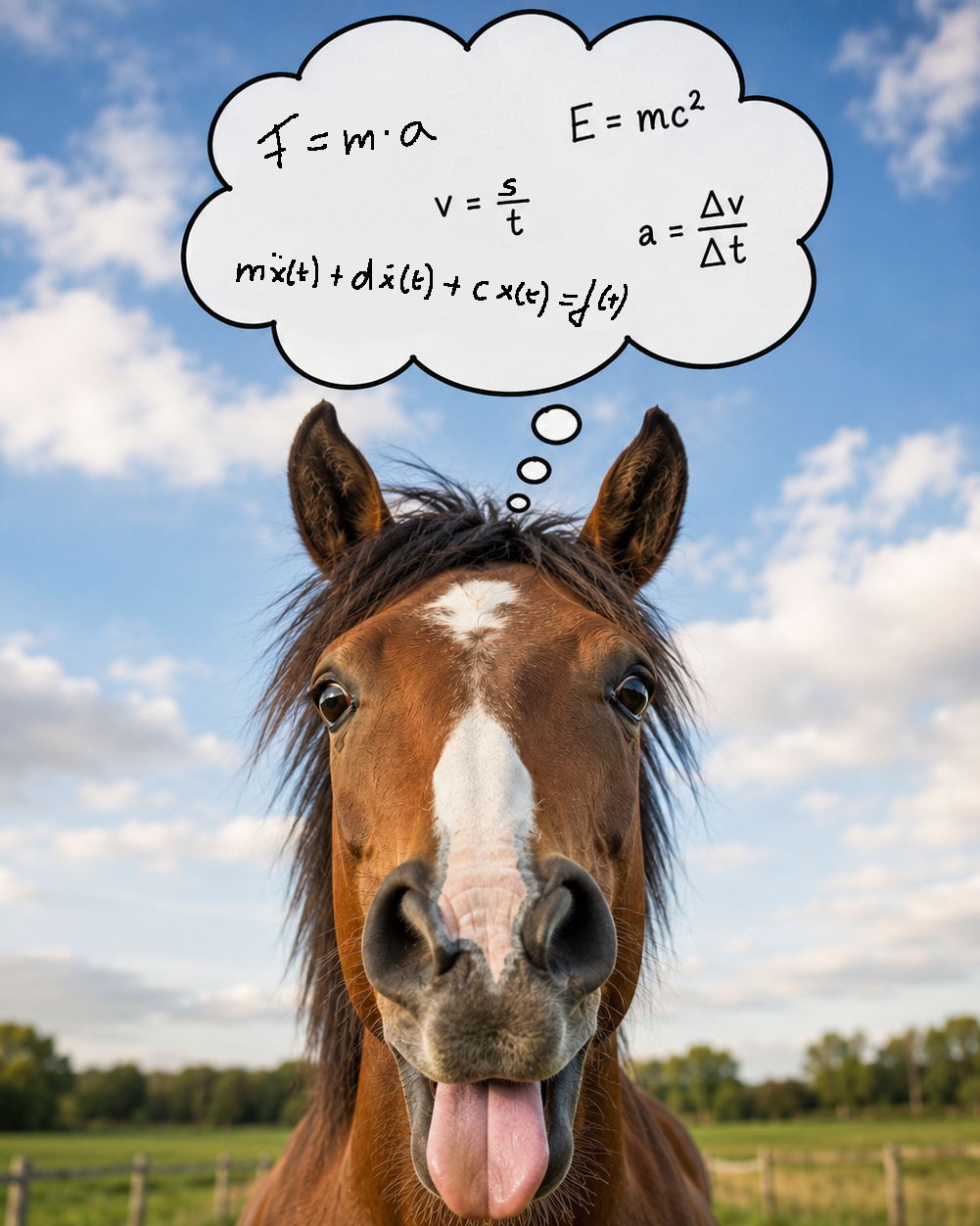
Almost everyone knows the phrase: "A horse has one horsepower."
It sounds so natural that hardly anyone questions it. After all, the unit is called horsepower. So a horse must have exactly one horsepower – right?
Not quite.
Because anyone who has ever watched a horse in motion knows: When a 600-kilogram warmblood shoots off from a standstill, it certainly doesn't feel like a single horsepower. More like a force of nature on four legs.
The truth is even more exciting. A horse does not have a fixed amount of horsepower. Its performance is constantly changing – depending on whether it is accelerating, jumping, working, or covering mile after mile.
The explosive start
Imagine a riding arena on a cool spring morning.
The horse stands quietly. Its ears are attentively pointed forward. A barely visible twitch goes through its muscles.
In an instant, the quiet calmness transforms into pure dynamic energy. The hindquarters and back work like a perfectly tuned spring mechanism. The hooves dig into the ground, sand flies through the air, and within a few gallop strides, the horse develops a power that is hard to believe.
In these few seconds, a well-trained horse reaches astonishing values.
About 30 to 40 HP of peak power output (the organism produces a multiple of this due to efficiency rates) are possible for a short time.
This performance does not come from the normal energy metabolism, but from the readily available energy stores in the muscles.
ATP and creatine phosphate provide immediate energy – but only for a few seconds. After that, the breakdown of muscle glycogen and finally the aerobic metabolism increasingly take over.
It's fireworks – impressive, but brief.
From fireworks to stamina
But every fireworks display ends.
Not because the horse suddenly runs out of strength. But because the body switches to a different energy system.
The explosive energy supply is gradually replaced by a much more efficient metabolism. The breathing becomes calmer, the movements more even, and the gallop suddenly seems almost effortless.
Now it is no longer maximum power that decides, but the ability to provide energy as efficiently as possible.
During intense sporting exertion, such as a fast cross-country ride in eventing, the power output is significantly below the sprint peak, but still at a high level.
Realistically, this is around 5 to 8 HP of continuous power during the load phases.
What is interesting here: Even a demanding cross-country ride is predominantly sustained by the aerobic metabolism. Studies on eventing horses show that more than 90% of the energy demand is provided by the oxygen metabolism. The anaerobic part plays a role mainly during short accelerations and obstacle phases.
The real superpower
Most engines impress with their peak performance.
Horses, on the other hand, impress with something else entirely.
With endurance.
Anyone who has ever followed an endurance ride experiences no spectacular sprints. Instead, you see horses that maintain an astonishingly high pace over many kilometers, executing every movement as energy-efficiently as possible.
Now the aerobic metabolism is mainly at work – slow, efficient, and reliable.
Over long distances, the power output is typically in the range of about 2 to 5 HP.
At first glance, this sounds much less impressive than the 40 HP of a sprint.
In reality, this is exactly the true masterpiece.
Because a short burst of strength is spectacular.
Maintaining a performance over hours is extraordinary.
Why horsepower still confuses us today
The real irony of the story, however, is the famous horsepower itself.
When James Watt wanted to sell his steam engines in the 18th century, he needed a comprehensible unit of comparison. So he observed draft horses and derived a unit of power from them.
That was clever marketing.
Since then, generations of people have believed that a horse possesses exactly one horsepower.
You might as well claim that every human can climb exactly one flight of stairs.
Sometimes leisurely.
Sometimes running.
Sometimes with a moving box on their shoulder.
Performance always depends on what is currently required.
How fast does a horse run continuously?
This difference is also evident in speed.
A horse can reach enormous top speeds in a gallop - in sprints, Quarter Horses have been measured unofficially at well over 80 km/h - the official record over 402m (a quarter mile) is just over 70 km/h. The length of a gallop stride at full racing speed is 6 to 7.5 meters per stride, exceptionally up to 8.5 meters.
Over long distances, however, it is not the record that counts, but consistency.
Well-trained horses move continuously at about 18 to 23 km/h – a pace they can maintain for an astonishingly long time.
Endurance horses in particular show impressively how perfectly nature and metabolism are designed for stamina.
What we can learn from this
Perhaps this is exactly where the biggest difference between an engine and a horse lies.
An engine only knows numbers.
A horse knows rhythm.
It accelerates, saves energy, adapts to the ground, reacts to its rider, and decides anew every second how much power makes sense.
Its performance is therefore not a fixed number on a rating plate.
It is alive.
Conclusion
So if you ask: "How much horsepower does a horse really have?", the most honest answer is:
It depends.
- In an explosive sprint, 30 to 40 HP are possible for a short time.
- During intense sporting exertion, for example in eventing, horses produce around 5 to 8 HP.
- Over long, sporting distances, a horse produces about 2 to 5 HP – and that is exactly where its true strength lies.
Perhaps that is the most beautiful realization of this short journey.
It is not the highest number that makes a horse impressive.
But rather the ability to combine power, endurance, and elegance in every single gallop stride.
Further Sources
- Marlin, D. J. & Nankervis, K. (2002): Equine Exercise Physiology. Blackwell Science.
- Evans, D. L. (2000): Training and Fitness in Athletic Horses. Rural Industries Research and Development Corporation.
- Weishaupt et al. (2025): Modelling Energy Demands of Cross-Country Tests in 2-Star to 5-Star Eventing Horses. Frontiers in Veterinary Science.
- Wickler et al. (2005): Energetics and biomechanics of equine locomotion.
 Whatsapp